Left Of Launch

The Perfect Weapon is an intriguing account of history’s most cunning cyberwarfare operations. I learned about the incremental evolution of cyberspace as the fifth domain of war and how policymakers, military leaders and the private technology sector continue to adapt to this new threat landscape.  

Much has been written about influence operations or cyber criminals, but few accounts present so clearly a link between national security, cyberspace and foreign policy. Some of the stories told in The Perfect Weapon touch upon the Russian interference in the 2016 presidential elections, the 2015 hack of the Ukrainian power grid, the 2014 Sony hack, the 2013 revelations by Edward Snowden and many other notable breaches of cybersecurity. These aren’t news anymore, but help to understand America’s 21st century vulnerabilities.

Chapter 8 titled “The Fumble” left a particular mark on me. In it, Sanger details the handling of Russian hackers infiltrating the computer and server networks of the Democratic National Committee. The sheer lethargy by officials at the time demonstrated over months on end, including Obama’s failure to openly address the ongoing cyber influence operations perpetrated by the Russians ahead of the elections, was nothing particularly new yet I still felt outraged by what now seems to be obvious. The chapter illustrates some governance shortcomings that we as a society need to overcome in order to address cyberattacks but also build better cyber defense mechanisms.

Left of Launch is a strategy to leverage cyberwarfare or other infrastructure sabotage to prevent ballistic missiles from being launched

But the most insights for me came from the books cross-cutting between the cyberspace/cybersecurity domain to the public policy domain. It showed me how much work is still left to be done to educate our elected officials, our leaders and ourselves about a growing threat landscape in cyberspace. While technology regulation is a partisan issue, only bi-partisan solutions will yield impactful results.

David E. Sanger is a great journalist, bestselling author and an excellent writer. His storytelling is concise, easy to read and accessible for a wide audience. Throughout the book, I never felt that Sanger allowed himself to get caught up in the politics of it but rather maintained a refreshing neutrality. His outlook is simple: we need to redefine our sense of national security and come up with an international solution for cyberspace. We need to think broadly about the consequences of cyber-enabled espionage and cyberattacks against critical infrastructures. And we need to act now.
Nations Fail, But Why?

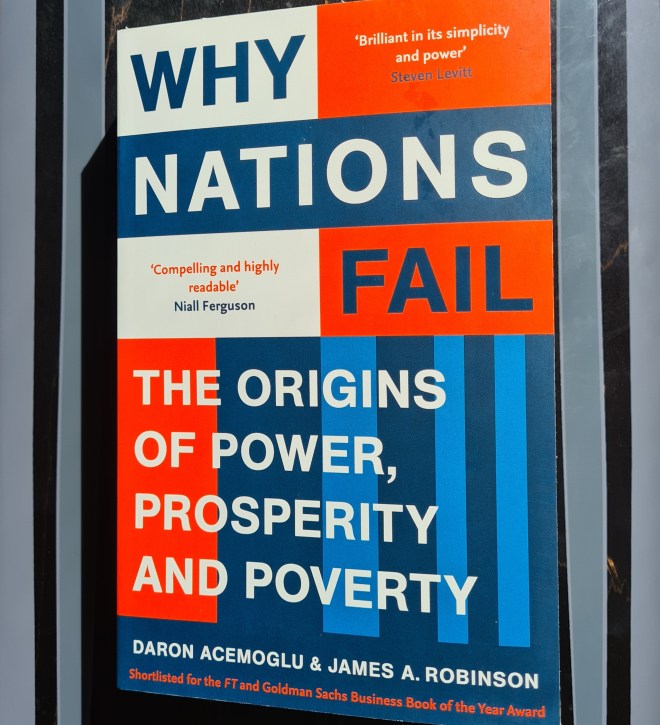
Is it because the culture of some nations is inferior to that of others? Is it because the natural resources of some nations are less fertile and valuable? Or is it because some nations are in more advantageous geographical locations? Daron Acemoglu and James A. Robinson argue the wealth of some nations can be traced back to their institutions – inclusive institutions to be precise that enable its citizens to partake in the political process and economic agenda. It’s an argument for a decentralized, democratic control structure with checks and balances to hold elected officials accountable and ensure shared economic benefits. Thus they conclude nations fail when a ruling elite creates extractive institutions designed to enrich only themselves on the back of the masses. More democracy is the answer to our looming political and economic problems according to the authors. Therefore political leaders must focus on the disenfranchised, the forgotten – those who have been left behind. It’s a conclusion hard to contend with. 

Altogether, though, this book is disappointing. Among the various economic theories that try to explain the wealth of nations, the authors fail to create quantifiable definitions for their premise. By failing to define inclusion and extraction the reader never learns about required elements, political structures and economic (minimum) metrics that can be measured or produce reliable data. Instead the authors appear to cherry-pick historic examples to demonstrate the perils of extraction and highlight the benefits of inclusive institutions. Throughout the book this reaches an absurd level of comparing contemporary nations with ancient nations without regard to (then) current affairs, social cohesion, trade or world events. This creates a confusing storyline jumping through unrelated examples from Venice to China to Zimbabwe to Argentina to the United States. I found the repetition of their inclusiveness and extraction argument quite draining for it seems to appear on every page. 

Why Nations Fail is an excellent history book full of examples for the success or failure of governance. The stories alone are well-researched, detailed and certainly a pleasure to read. However the author’s explanation for the economic failure of nations is vague and conjecture at best. They fail to answer the origins of power with quantifiable evidence and how prosperous (or poor) nations manipulate power. Altogether this book would have been awesome if it were reduced to a few hundred pages and less repetitive.

The Universe, Explained By Neil deGrasse Tyson

When I think about the universe, distant galaxies and the concept of time I feel easily overwhelmed. The cosmos seems detached from my earthly, daily life with my meaningless human problems. To understand it seems to require complex mathematics and in-depth proficiency in advanced physics. This often leads to a feeling of intimidation. Something observed throughout human history. Neil deGrasse Tyson is a master of translating the comprehensive and complex theories of astrophysics into layman’s terms. He’s quite the opposite of being intimidated when it comes to the universe. With his concise and intriguing book Astrophysics For People In A Hurry he offers an in-route for us mere mortals to learn more about the universe and by extension – us. 

I generally don’t like hardcover editions but this one is in a perfect size to page ratio, which only increased my excitement. Appropriate reader’s break points are strategically placed every other twenty pages. This creates a welcoming reader’s feel of brevity of a book that is already edited down to just 208 pages. Rest assured though Neil deGrasse Tyson delivers on his reputation to explain the science of the universe as a human endeavor: the first few chapters cover the origins of our story. Explaining the big bang theory that is not a TV show with an historic account enriched with analogies such as

“we are stardust brought to life, then empowered by the universe to figure itself out – and we have only just begun.”

Against this backdrop, Neil deGrasse Tyson continues to detail the concepts of orbiting planets, which form galaxies. Earth is part of the Milky Way galaxy. Examining galaxy clusters with basic laws of physics revealed dark matter “which makes no assertion that anything is missing, yet nonetheless implies that some new kind of matter exists, waiting to be discovered.” And if planets, galaxies, multiverses and dark matter aren’t blowing your mind already then dark energy might just get you there. Dark energy is presumably “a quantum effect where the vacuum of space, instead of being empty, actually seethes with particles and their antimatter counterparts. They pop in and out of existence in pairs, and don’t last long enough to be measured.”

Next, Neil deGrasse Tyson does us all a favor by refreshing our memory of the periodic table in a short chemistry of the universe breakdown. It’s remarkable that I could unclutter some semblance of understanding throughout this section having loathed chemistry class in high school. Did you know that the Macy’s Thanksgiving Day parade is the second largest consumer of helium second only to the U.S. military? Or that uranium, neptunium and plutonium all follow one another in the periodic table and all lend their names to later discovered planets? Except for Pluto, of course, who was added as a planet under false pretenses assuming it’d be equal in size and mass to our earth (It isn’t. And Pluto is not a planet.) In his concluding remarks, Neil deGrasse Tyson demonstrates the humbling effects of cosmology on our existence as we humans are a mere smudge on the hourglass of time. He offers a philosophical way forward to set aside human conflict for our drive to explore and grow our minds.

Astrophysics For People In A Hurry is a page-turner, but not as easy as one would hope. Some preexisting knowledge will help to follow the astrophysics theories presented in this book. Albeit some theories were over my head anyway. Nonetheless, the message of this book is not so much about feeling overwhelmed and intimidated but an openness to learning, exploring and to embrace the unknown. Neil deGrasse Tyson does well communicate that we’re not just part of this universe, but its core ingredients are within us. We are the universe. 

I’ll leave you with Neil deGrasse Tyson’s eloquent yet mind-boggling answer to the question: “What is the most astounding fact you can share with us about the universe?” 

One Flew Over The Bitcoin Mine

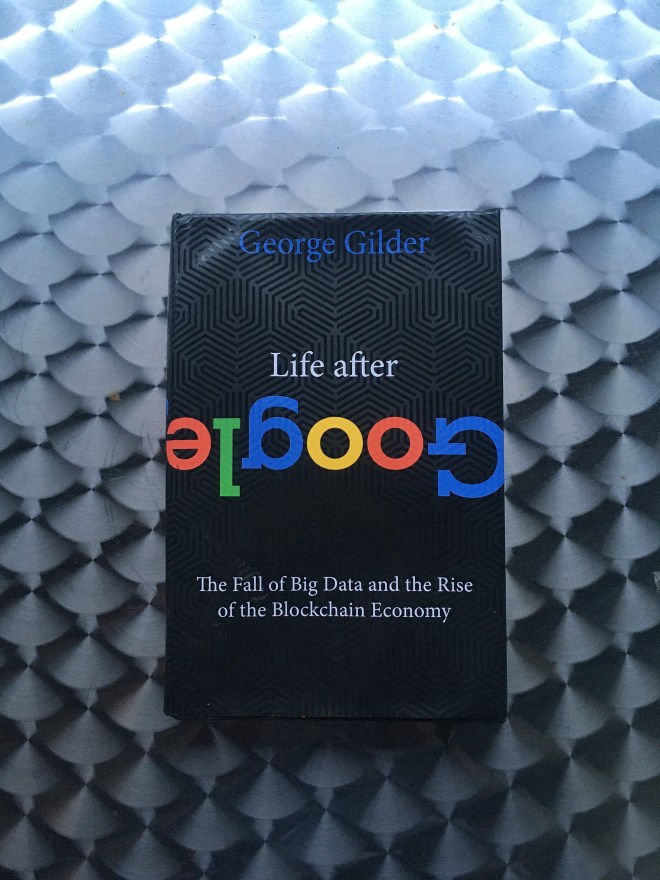
Rarely have I found myself more confused about technology than after reading George Gilder’s “Life After Google – The Fall of Big Data and the Rise of the Blockchain Economy.” A book, supposedly, on the very technology of big data and the blockchain.

In twenty-five chapters across 276 pages, the author attempts to show off but not discuss, how the internet as we know it came into our daily lives. Gilder uses a wealth of buzzwords without ever defining them for the reader. The compounding effect of broad terminology, out-of-place analogies that seemingly disrupt the storytelling, make this book a dense and frustrating read. Even for the tech-savvy. He moves from monetary theory to artificial intelligence to silicon valley startup culture without skipping a beat. Until the underwhelming end of the book, I failed to understand the author’s rage against Google and new, emerging technology companies. In the absence of a clear theme of this book, I tried to theorize that the author set out to warn against Google’s free products, attempts to predict the end of the free product business model as the economy is moving towards cryptographic ledgers, most notably blockchain technology and decentralized cryptocurrency. However, Gilder then compares bitcoin to gold and points out the flaws of a scarce resource to become a stable coin in an economy. How this all ties together or even argues for a future with a decreased need of big data processing remains unclear. Why he chose not to discuss cybersecurity as the most potent threat to fiduciaries within a digitalized, capitalistic system remains unclear. This book is incoherent while being overly focused on ideological aspects. It would have served the readers to restrict the discussion to the actual technology.

With all that in mind, I feel this book has some minuscule merit for a philosophical audience without much need for technical detail. Gilder delivers on creating an entry-level overview for future exploration of blockchain technology, large scale computing and its implementation within an economic system that is supported by for-profit corporations. But beyond that, I feel, I am left more confused than enlightened about the interplay between data processing within financial markets, artificial intelligence deployed to equalize market barriers and blockchain as technology that would enable a seismic shift towards decentralized currencies. 

Just Try One More

And find out what you are made of. In her autobiography, American ultra-marathon open water swimmer and international swimming hall of famer, Penny Lee Dean describes overcoming life’s adversities and conquering the elements when you just try one more.

Water is an unforgiving element. The oceans are a hostile domain for man. Unlike land, where an ultra-marathon runner may rest during a grueling 100 mile race, the open waters have no mercy: stop swimming and you’ll die. This makes swimming an intriguing sport for many athletes. When it comes to long-distance swimming, however, there are few people as groundbreaking as Penny Lee Dean.

As a native of California, her childhood is marked by moving around several swimming clubs across the Bay Area. Through a series of setbacks within short-distance races Penny identified her talent and passion for endurance swimming. Those early days were filled with invaluable lessons to improve swimming style and to build up mental and physical strength. The longer the swims, the more she needed to acknowledge pain and then go beyond it.

“In marathon swimming, more than in any other sport, the mental attitude is at least 85 percent of the battle.”

What I found fascinating about Penny Lee Dean is her early dream of swimming the English Channel. This goal weaves like a red thread throughout this book. It guides and drives all her important decisions. And in order to make her dream become a reality she was fortunate enough to have an influential coach: Siga Rose. They quickly became a high-performing unit with Siga taking Penny to the next level in a dynamic, ever-changing ocean environment. Persistent training in the ocean with increasing distances elevated Penny into a position where she would attempt to swim 22 miles across open water from Los Angeles to Catalina crossing the Catalina Channel.

Her relationship with her family, in particular her mother, is fraught with a deep struggle for love and compassion. Her account of her mother appears like a pendulum that would swing from love and care to not feeling supported and left vulnerable. While her mother was instrumental to find the best coaches and teammates available in the early 1970s Penny also saw the relationship of her mother and father break apart. The emotional struggle with it helped her to build up a mental fortitude that is fueled by an intensity to go further, faster.

Despite her personal adversities with her family, her internal battles against herself, Penny always found her way back to just try one more and see where it would take her. With this unshakable attitude she overcame unimaginable physical pain, emotional stress, jellyfish and the mental trepidation when faced with dynamic swells, waves, high winds and ever changing open water conditions. 

I found many invaluable lessons in Penny Lee Dean’s autobiography. Her description of building up mental toughness through setting affirmations, repeating affirmations and linking those affirmations to concrete goals are commonplace nowadays, but her story takes place in the 1970s when amateur and professional sports were far from scientifically researched as they are nowadays. I was also intrigued by her daily, unwavering discipline. It almost appears as if her daily schedule didn’t change for about two decades: rise by 6am, training in between 6:45am to 6pm, and in bed by 9pm. It speaks to the sacrifices athletes must take on in order to achieve greatness. But it also speaks to the level of passion and dedication she had for the sport. While I chose this book to learn more about overcoming the elements and testing myself in the open waters I sure don’t see myself swimming at ultra-marathon distances. However, the beauty of this autobiography is its simple message: just try one more when you feel you can’t go any further. It’s applicable to your studies, to your family or work struggles or when life hit you hard. Just Try One More is just that: don’t think, do it.