A Nudge Too Far

The premise for our decisions is often influenced by imperfect information. This leads us to make poor decisions. Yet even when we have access to perfect information, we tend to make poor decisions due to our reliance on mental shortcuts, false believes, and the influence of social interactions. Nudge, written by Richard Thaler and Cass Sunstein in 2008, attempts to improve our decisions about health, wealth, and happiness. [Note: a newer, final edition was published in 2021.]


This book centers around the concept of nudges, behavioral psychology and economics. Nudges are small, simple changes to the environment or choices presented to people to influence their decision without undermining their freedom of choice. In the words of Thaler and Sunstein:

“A nudge is any aspect of the choice architecture that alters people’s behavior in a predictable way without forbidding any options or significantly changing their economic incentives. To count as a mere nudge, the intervention must be easy and cheap to avoid. Nudges are not mandates. Putting fruit at eye level counts as a nudge. Banning junk food does not.”

Effective “nudges” are the result of what Thaler calls “choice architectures”: Instances in which people actively design menus, store layouts and other environments in which other people make decisions, such that design attributes “nudge” users’ decisions in certain directions. Free choice doesn’t necessarily lead to good decisions, according to Thaler, especially in cases with too many options. For example, in one large company’s health insurance package, employees were offered 48 possible plans, which led many to choose plans which were financially worse for them than the default plan. The book continues with a wealth of examples applicable to a plethora of social transactions. 

Thaler’s premise for choice architecture is the concept of liberal paternalism. In other words, private and public institutions are allowed and encouraged to affect citizen’s behavior while also respecting freedom of choice and the outcome of choice. There are obvious drawbacks to this concept namely lack of clear boundaries, distributive injustice, and to an extreme extend it poses an insult to (human) autonomy. 

In conclusion, I could have had the same learning experience by limiting my time to the first five chapters of part one and the last four chapters of part five of this book. Part two to four aren’t really new information but examples and justifications for their theory of libertarian paternalism and choice architecture. I recommend these parts for quick access to a specific situation for they can be consumed standalone out of context. For a casual drive or background listen, I found the Freakonomics episode on Nudging to be entertaining.

Ballistic Books: Sales Books You Need To Read

Everything in life is a negotiation. Everyone alive is a salesperson.

Sales are the backbone of any enterprise. Sales establish trust and rapport between the company and its customers. Sales directly influence crucial financial metrics. Therefore, a company’s ability to compete against stiff competition. Yet, sales isn’t really a subject in our basic education. Mastering the art of sales, however, can make the difference between a good life and a great life. In an effort to learn more about the art of salesmanship, I bought three more or less fundamental books about the process of selling. 

How To Master The Art Of Selling By Tom Hopkins

Tom Hopkins learned early on that sales is “the highest-paid hard work — and the lowest-paid easy work.” It can be an easy endeavor without much effort to make ends meet or it can be the greatest adventure and highest reward ever experienced. It is entirely up to the salesman. But, it requires craft, skill, and expertise to be honed frequently and stress-tested often. Buy Hopkins at ThriftBooks.

Sell It Like Serhant By Ryan Serhant

Ryan Serhant made a splash on Million Dollar Listing New York. In his book, he argues that anybody can become a salesman. Furthermore, anyone can get lucky and accomplish one huge sale. But can you repeat the sale? Can you consistently sell at a high profit margin? Sales is not about one sale; it’s about every sale you make. Buy Serhant at Barnes & Noble.

Zig Ziglar’s Secrets Of Closing The Sale

Hillar Hinton “Zig” Ziglar was a college dropout turned salesman who would redfine the art of selling. He described himself as a pack rat taken copious notes from many great salesman over a lifetime of sales. In “Closing The Sale” Ziglar outlines fundamental strategies to take the sales pitch from zero to one. From psychological sales aspects that differ when it comes to closing the sale to the necessity of objections and resistance when you’re in the eye of the hurricane; the toughest part of any sales negotiation, Ziglar structured his book as a manifesto, ready to read rather than a cover-to-cover liaison. Buy Ziglar at (the) Book Depository.

Ballistic books is a series to present literature of interest. Each edition is dedicated to a specific topic. I found it challenging to discover and distinguish good from great literature. With this series, I aim to mitigate that challenge.

Hit Hard, Hit Everyone, And Hit Them All At Once

Supreme Court Justice Louis Brandeis viewed big government and big corporations as symptoms of a “curse of bigness”. Their sheer size places a stranglehold around the democratic neck of economic freedom, or, to put it in simple terms: it takes away choice. Tim Wu, who is a law professor at Columbia University, argues in his most recent book “The Curse of Bigness: Antitrust in the New Gilded Age” to break up modern, large trusts of the digital age to immediately boost free market competition. But, in order to understand how he got to this conclusion, it is necessary to take a closer look at the historical context and how antitrust law and economic policy developed throughout some of the most impactful years for the United States of America. 

tl;dr

This paper is a supplement to the book “The Curse of Bigness: Antitrust in the New Gilded Age.” It covers the years between 1920-1945, with a focus on the New Deal, and represents material left out of the original book.

Make sure to read the full supplement titled The Curse of Bigness: New Deal Supplement between chapters 3 and 4 of the book with the same title by Tim Wu at https://papers.ssrn.com/sol3/papers.cfm?abstract_id=3646258

Thurman Arnold speaks with a subcommittee of the Senate Judiciary Committee in March 1938. (Source: WyoHistory.org)

In this supplement, Wu covers how the United States experimented with central planning and policies resulting in a state-managed economy similar to communism in the Soviet Union or state-sponsored socialism in Italy or Germany only to fail catastrophically. He goes on to detail large chain retailers’ quest against the Robinson-Patman Act. The J.C. Penneys, Sears, and Woolworths of the era. Lastly, he takes a look at Alcoa and the question of the benign monopoly. Is it beneficial to allow a single player to dominate a market segment when it offers fair prices without any apparent economic harm? To this, Federal Appellate Court Justice Billings Learned Hand had to state: 

“The Sherman Act has wider purposes. Many people believe that possession of unchallenged economic power deadens initiative, discourages thrift, and depresses energy; that immunity from competition is a narcotic, and rivalry is a stimulant to industrial progress; that the spur of constant stress is necessary to counteract an inevitable disposition to let well enough alone.”

Perhaps what makes this supplement great and worth a read is Wu’s historical account of Thurman Arnold. President Franklin D. Roosevelt appointed little-known Arnold from Wyoming to become the U.S. Attorney General for the Antitrust Division in 1938. Unlike any other antitrust enforcer before or since, Arnold went on to file 1,375 complaints in 213 prosecutions involving 40 industries, while pursuing 185 investigations – all by 1939. Arnold went after the car industry, the film industry, big pharma, big banks, and so many more. His strategy would become known as “shock treatment” whereby a lawsuit would target not just one monopolist, but all its vertically and horizontally integrated co-conspirators. It was as simple as “hit hard, hit everyone, and hit them all at once.”

This supplement is a must-read if you are about or in the process of reading the curse of bigness. If you have ever seen “The Men Who Built America” the historical context of the supplement will serve as valuable knowledge. If you rather watch Tim Wu talk about his book and his learnings, watch this

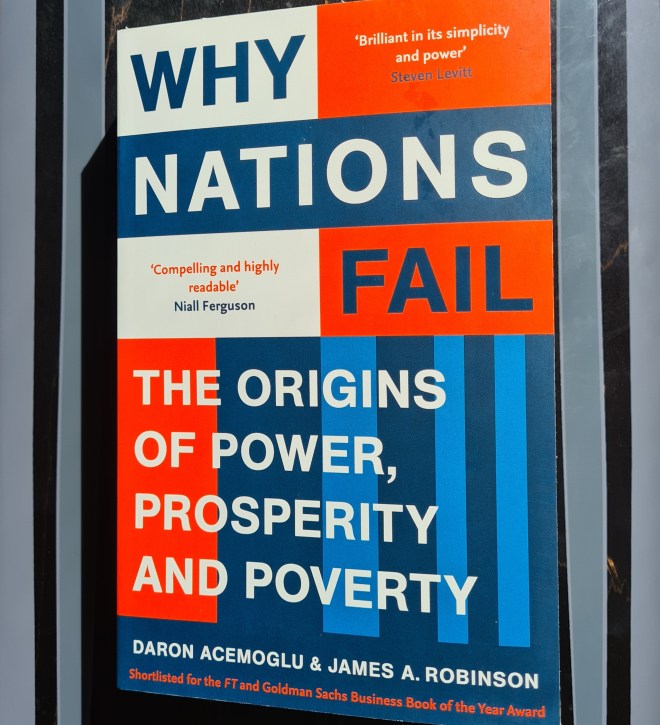
Nations Fail, But Why?

Is it because the culture of some nations is inferior to that of others? Is it because the natural resources of some nations are less fertile and valuable? Or is it because some nations are in more advantageous geographical locations? Daron Acemoglu and James A. Robinson argue the wealth of some nations can be traced back to their institutions – inclusive institutions to be precise that enable its citizens to partake in the political process and economic agenda. It’s an argument for a decentralized, democratic control structure with checks and balances to hold elected officials accountable and ensure shared economic benefits. Thus they conclude nations fail when a ruling elite creates extractive institutions designed to enrich only themselves on the back of the masses. More democracy is the answer to our looming political and economic problems according to the authors. Therefore political leaders must focus on the disenfranchised, the forgotten – those who have been left behind. It’s a conclusion hard to contend with. 

Altogether, though, this book is disappointing. Among the various economic theories that try to explain the wealth of nations, the authors fail to create quantifiable definitions for their premise. By failing to define inclusion and extraction the reader never learns about required elements, political structures and economic (minimum) metrics that can be measured or produce reliable data. Instead the authors appear to cherry-pick historic examples to demonstrate the perils of extraction and highlight the benefits of inclusive institutions. Throughout the book this reaches an absurd level of comparing contemporary nations with ancient nations without regard to (then) current affairs, social cohesion, trade or world events. This creates a confusing storyline jumping through unrelated examples from Venice to China to Zimbabwe to Argentina to the United States. I found the repetition of their inclusiveness and extraction argument quite draining for it seems to appear on every page. 

Why Nations Fail is an excellent history book full of examples for the success or failure of governance. The stories alone are well-researched, detailed and certainly a pleasure to read. However the author’s explanation for the economic failure of nations is vague and conjecture at best. They fail to answer the origins of power with quantifiable evidence and how prosperous (or poor) nations manipulate power. Altogether this book would have been awesome if it were reduced to a few hundred pages and less repetitive.

One Flew Over The Bitcoin Mine

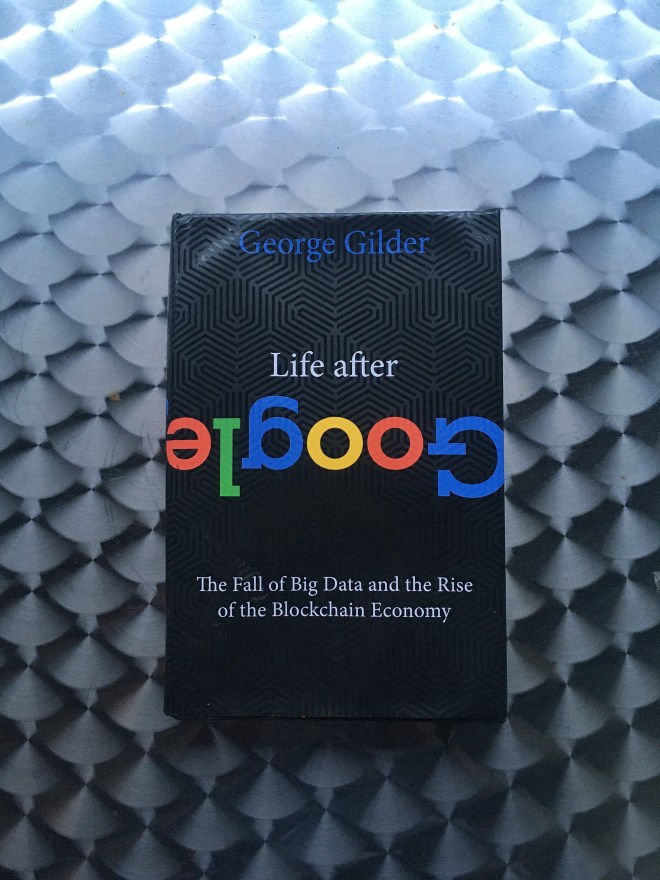
Rarely have I found myself more confused about technology than after reading George Gilder’s “Life After Google – The Fall of Big Data and the Rise of the Blockchain Economy.” A book, supposedly, on the very technology of big data and the blockchain.

In twenty-five chapters across 276 pages, the author attempts to show off but not discuss, how the internet as we know it came into our daily lives. Gilder uses a wealth of buzzwords without ever defining them for the reader. The compounding effect of broad terminology, out-of-place analogies that seemingly disrupt the storytelling, make this book a dense and frustrating read. Even for the tech-savvy. He moves from monetary theory to artificial intelligence to silicon valley startup culture without skipping a beat. Until the underwhelming end of the book, I failed to understand the author’s rage against Google and new, emerging technology companies. In the absence of a clear theme of this book, I tried to theorize that the author set out to warn against Google’s free products, attempts to predict the end of the free product business model as the economy is moving towards cryptographic ledgers, most notably blockchain technology and decentralized cryptocurrency. However, Gilder then compares bitcoin to gold and points out the flaws of a scarce resource to become a stable coin in an economy. How this all ties together or even argues for a future with a decreased need of big data processing remains unclear. Why he chose not to discuss cybersecurity as the most potent threat to fiduciaries within a digitalized, capitalistic system remains unclear. This book is incoherent while being overly focused on ideological aspects. It would have served the readers to restrict the discussion to the actual technology.

With all that in mind, I feel this book has some minuscule merit for a philosophical audience without much need for technical detail. Gilder delivers on creating an entry-level overview for future exploration of blockchain technology, large scale computing and its implementation within an economic system that is supported by for-profit corporations. But beyond that, I feel, I am left more confused than enlightened about the interplay between data processing within financial markets, artificial intelligence deployed to equalize market barriers and blockchain as technology that would enable a seismic shift towards decentralized currencies.