One Flew Over The Bitcoin Mine

Rarely have I found myself more confused about technology than after reading George Gilder’s “Life After Google – The Fall of Big Data and the Rise of the Blockchain Economy.” A book, supposedly, on the very technology of big data and the blockchain.
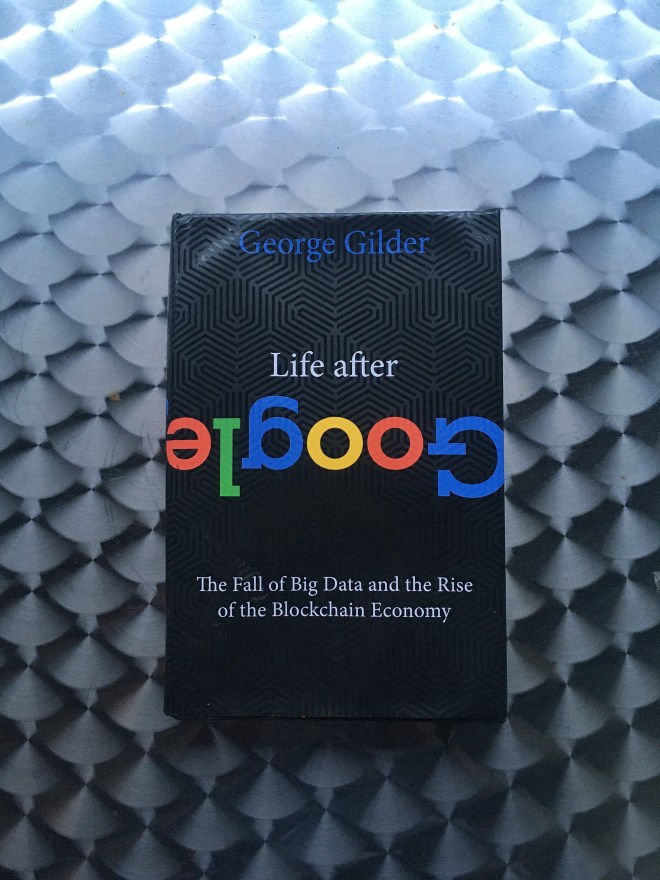
In twenty-five chapters across 276 pages, the author attempts to show off but not discuss, how the internet as we know it came into our daily lives. Gilder uses a wealth of buzzwords without ever defining them for the reader. The compounding effect of broad terminology, out-of-place analogies that seemingly disrupt the storytelling, make this book a dense and frustrating read. Even for the tech-savvy. He moves from monetary theory to artificial intelligence to silicon valley startup culture without skipping a beat. Until the underwhelming end of the book, I failed to understand the author’s rage against Google and new, emerging technology companies. In the absence of a clear theme of this book, I tried to theorize that the author set out to warn against Google’s free products, attempts to predict the end of the free product business model as the economy is moving towards cryptographic ledgers, most notably blockchain technology and decentralized cryptocurrency. However, Gilder then compares bitcoin to gold and points out the flaws of a scarce resource to become a stable coin in an economy. How this all ties together or even argues for a future with a decreased need of big data processing remains unclear. Why he chose not to discuss cybersecurity as the most potent threat to fiduciaries within a digitalized, capitalistic system remains unclear. This book is incoherent while being overly focused on ideological aspects. It would have served the readers to restrict the discussion to the actual technology.

With all that in mind, I feel this book has some minuscule merit for a philosophical audience without much need for technical detail. Gilder delivers on creating an entry-level overview for future exploration of blockchain technology, large scale computing and its implementation within an economic system that is supported by for-profit corporations. But beyond that, I feel, I am left more confused than enlightened about the interplay between data processing within financial markets, artificial intelligence deployed to equalize market barriers and blockchain as technology that would enable a seismic shift towards decentralized currencies. 

Just Try One More

And find out what you are made of. In her autobiography, American ultra-marathon open water swimmer and international swimming hall of famer, Penny Lee Dean describes overcoming life’s adversities and conquering the elements when you just try one more.

Water is an unforgiving element. The oceans are a hostile domain for man. Unlike land, where an ultra-marathon runner may rest during a grueling 100 mile race, the open waters have no mercy: stop swimming and you’ll die. This makes swimming an intriguing sport for many athletes. When it comes to long-distance swimming, however, there are few people as groundbreaking as Penny Lee Dean.

As a native of California, her childhood is marked by moving around several swimming clubs across the Bay Area. Through a series of setbacks within short-distance races Penny identified her talent and passion for endurance swimming. Those early days were filled with invaluable lessons to improve swimming style and to build up mental and physical strength. The longer the swims, the more she needed to acknowledge pain and then go beyond it.

“In marathon swimming, more than in any other sport, the mental attitude is at least 85 percent of the battle.”

What I found fascinating about Penny Lee Dean is her early dream of swimming the English Channel. This goal weaves like a red thread throughout this book. It guides and drives all her important decisions. And in order to make her dream become a reality she was fortunate enough to have an influential coach: Siga Rose. They quickly became a high-performing unit with Siga taking Penny to the next level in a dynamic, ever-changing ocean environment. Persistent training in the ocean with increasing distances elevated Penny into a position where she would attempt to swim 22 miles across open water from Los Angeles to Catalina crossing the Catalina Channel.

Her relationship with her family, in particular her mother, is fraught with a deep struggle for love and compassion. Her account of her mother appears like a pendulum that would swing from love and care to not feeling supported and left vulnerable. While her mother was instrumental to find the best coaches and teammates available in the early 1970s Penny also saw the relationship of her mother and father break apart. The emotional struggle with it helped her to build up a mental fortitude that is fueled by an intensity to go further, faster.

Despite her personal adversities with her family, her internal battles against herself, Penny always found her way back to just try one more and see where it would take her. With this unshakable attitude she overcame unimaginable physical pain, emotional stress, jellyfish and the mental trepidation when faced with dynamic swells, waves, high winds and ever changing open water conditions. 

I found many invaluable lessons in Penny Lee Dean’s autobiography. Her description of building up mental toughness through setting affirmations, repeating affirmations and linking those affirmations to concrete goals are commonplace nowadays, but her story takes place in the 1970s when amateur and professional sports were far from scientifically researched as they are nowadays. I was also intrigued by her daily, unwavering discipline. It almost appears as if her daily schedule didn’t change for about two decades: rise by 6am, training in between 6:45am to 6pm, and in bed by 9pm. It speaks to the sacrifices athletes must take on in order to achieve greatness. But it also speaks to the level of passion and dedication she had for the sport. While I chose this book to learn more about overcoming the elements and testing myself in the open waters I sure don’t see myself swimming at ultra-marathon distances. However, the beauty of this autobiography is its simple message: just try one more when you feel you can’t go any further. It’s applicable to your studies, to your family or work struggles or when life hit you hard. Just Try One More is just that: don’t think, do it.     

Threat Mitigation In Cyberspace

Richard A. Clarke and Robert K. Knake provide a detailed rundown of the evolution and legislative history of cyberspace. The two leading cybersecurity experts encourage innovative cyber policy solutions to mitigate cyberwar, protect our critical infrastructure and help citizens to prevent cybercrime.

The Fifth Domain, commonly referred to as cyberspace, poses new challenges for governments, companies and citizens. Clarke and Knake discuss the historic milestones that led to modern cybersecurity and cyber policy. With detailed accounts of how governments implement security layers in cyberspace, gripping examples of breaches of cybersecurity and innovative solutions for policymakers, this book ended up rather dense in content – a positive signal for someone interested in cybersecurity, but fairly heavy for everybody else. Some of the content widely circulated the news media, other content is intriguing and through-provoking. While the policy solutions in this book aren’t ground-breaking, the authors provide fuel for policymakers and the public to take action on securing data, but, perhaps more importantly, to start developing transparent, effective cyber policies that account for the new, emerging technologies within machine learning and quantum computing. Personally, I found the hardcover edition too clunky and expensive. Six parts over 298 pages, however, made reading this book a breeze.

Understanding America

When I first arrived in New York City, this most portrayed American city appeared intimidating with its never-ending concrete jungles, incessant traffic and an overwhelmingly fast-paced populace. It made me wonder, is this the land of the free? Is this what America is like? Fast-forward a couple decades when the United States finds itself polarized, divided and void of compassion, insecure about its future. In times like these, I was looking for its identity. An identity forged by openness not oppression. A dear family member recommended reading “Travels with Charley in search of America” by John Steinbeck. It would become a starting point of how we got here.    

Steinbeck’s travelogue is comprised of simple ingredients: a man and his best friend, a three-quarter-ton pick up truck, and the wide and open roads of America. His best friend, a poodle named Charley is a main character in this non-fiction novel. His pick up truck Rocinante loads a little camper designed for housing. The duo is road tripping across rural America, sleeping wherever Rocinante finds a parking spot and a theme of this philosophical journey is to engage strangers in conversation over a cup of coffee. While this adventure takes place  in the America of the 1960s, it is somehow a timeless reflection of America’s soul. In somber passages, Steinbeck describes the struggle of Black Americans for equality. In more uplifting parts, he paints an American identity imbued in the spirit of tall, green Sequoias, who have seen all of history’s main events – free of discrimination. It’s a book about America, the beautiful, the ugly and the never-finished. Much as Steinbeck didn’t know his country in the 1960s, I don’t know my country in the 2020s: 

“I did not know my own country. I, an American writer, writing about America, was working from memory, and the memory is at best a faulty, warpy reservoir. I had not heard the speech of America, smelled the grass and trees and sewage, seen its hills and water, its color and quality of light. I knew the changes only from books and newspapers. But more than this, I had not felt the country for twenty-five years. In short, I was writing of something I did not know about”

Nevertheless, acknowledging a lack of knowledge is the first step in learning. “Travels with Charley in search of America” is an important piece of American literature. Its authentic historical account, its poetic beauty and the felt tragedy that is this great American democracy live on in our generation. What will we learn from it? 

Ballistic Books: Space Exploration

Elon Musk’s SpaceX has redefined space exploration. Jeff Bezos Blue Origin is in a close second of a Billionaire Space Race. These efforts to elevate humanity made me wonder about our place as humans in this universe but perhaps more importantly where we will venture in the future. Now, I have no solid knowledge of physics, math or science fiction. Like many, I dreaded these subjects in school. It’s reason enough to challenge myself. One book is a must-read for me, Astrophysics for People in a Hurry, for I am a great admirer of the works of Neil deGrasse Tyson. A Brief History of Time sort of made the list because it was written by Stephen Hawking, who is synonymous with both endless possibilities and making sense of our universe. From here I will rely on colleagues’ recommendations. The Future of Humanity seems to offer answers to my pressing questions: when will humanity leave earth? What will human life in the universe look like? Aside from this Michio Kaku appears to be a great lecturer. Lastly, Until The End of Time by Brian Greene strikes me as a perfect conclusion of elevating my mind into these far-fetched, astronomical Gedankenexperiments.    

Ballistic books is a series to present literature of interest. Each edition is dedicated to a specific topic. I found it challenging to discover and distinguish good from great literature. With this series, I aim to mitigate that challenge.

1. Astrophysics for People in a Hurry by Neil deGrasse Tyson

Neil deGrasse Tyson is an Astrophysicist, Frederick P. Rose Director at the Hayden Planetarium and host of StarTalk. You can find Neil deGrasse Tyson on Twitter at @neiltyson

2. A Brief History of Time by Stephen Hawking

Stephen Hawking was a theoretical physicist and director at the Centre for Theoretical Cosmology at the University of Cambridge. Hawking’s research enabled the study of black holes. His life inspired many people and was portrayed by Hollywood in The Theory of Everything in 2014. You can learn more about Stephen Hawking’s fascinating life and research at https://www.hawking.org.uk/  

3. The Future of Humanity: Our Destiny in the Universe by Michio Kaku

Michio Kaku is a theoretical physicist and a professor of theoretical physics at the City College of New York and CUNY Graduate Center. He is known for his research on string field theory. Kaku brought astrophysics to a broad audience through frequent television appearances, public events and is the author of many popular books on space exploration. You can find Michio Kaku on Twitter @michiokaku

4. Until The End of Time by Brian Greene

Brian Greene is a theoretical physicist, string theorist and a professor at Columbia University. Greene made some groundbreaking discoveries in his field, which I fail to grasp yet and won’t pretend to understand by listing them here. He recently went on the Joe Rogan Podcast, which offers a glimpse into his, our universe. You can find Brian Greene on Twitter @bgreene