The Future Of Political Elections On Social Media

Should private companies decide what politician people will hear about? How can tech policy make our democracy stronger? What is the role of social media and journalism in an increasingly polarized society? Katie Harbath, a former director for global elections at Facebook discusses these questions in a lecture about politics, policy and democracy. Her unparalleled experience as a political operative combined with her decade long experience working on political elections across the globe make her a leading intellectual voice to shape the future of civic engagement online. In her lecture to honor the legacy of former Wisconsin State senator Paul Offner she shares historical context on the evolution of technology and presidential election campaigns. She also talks about the impact of the 2016 election and the post-truth reality online that came with the election of Donald Trump. In her concluding remarks she offers some ideas for future regulations of technology to strengthen civic integrity as well as our democracy and she answers questions during her Q&A.

tl;dr

As social media companies face growing scrutiny among lawmakers and the general public, the La Follette School of Public Affairs at University of Wisconsin–Madison welcomed Katie Harbath, a former global public policy director at Facebook for the past 10 years, for a livestreamed public presentation. Harbath’s presentation focused on her experiences and thoughts on the future of social media, especially how tech companies are addressing civic integrity issues such as free and hate speech, misinformation and political advertising.

Make sure to watch the full lecture titled Politics and Policy: Democracy in the Digital Age at https://lafollette.wisc.edu/outreach-public-service/events/politics-and-policy-democracy-in-the-digital-age (or below)

Timestamps

03:04 – Opening remarks by Susan Webb Yackee
05:19 – Introduction of the speaker by Amber Joshway
06:59 – Opening remarks by Katie Harbath
08:24 – Historical context of tech policy
14:39 – The promise of technology and the 2016 Facebook Election
17:31 – 2016 Philippine presidential election
18:55 – Post-truth politics and the era of Donald J. Trump
20:04 – Social media for social good
20:27 – 2020 US presidential elections 
22:52 – The Capitol attacks, deplatforming and irreversible change
23:49 – Legal aspects of tech policy
24:37 – Refresh Section 230 CDA and political advertising
26:03 – Code aspects of tech policy
28:00 – Developing new social norms
30:41 – More diversity, more inclusion, more openness to change
33:24 – Tech policy has no finishing line
34:48 – Technology as a force for social good and closing remarks

Q&A

(Click on the question to watch the answer)

1. In a digitally democratized world how can consumers exercise their influence over companies to ensure that online platforms are free of bias?

2. What should we expect from the congressional hearing on disinformation?

3. Is Facebook a platform or a publisher?

4. Is social media going to help us to break the power of money in politics?

4. How have political campaigns changed over time?

5. What is the relationship between social media and the ethics of journalism?

6. Will the Oversight Board truly impact Facebook’s content policy?

7. How is Facebook handling COVID-19 related misinformation?

8. What is Facebook’s approach to moderating content vs encryption/data privacy?

9. Does social media contribute to social fragmentation (polarization)? If so, how can social media be a solution for reducing polarization?

10. What type of regulation should we advocate for as digitally evolving voters?

11. What are Katies best and worst career memories? What’s next for Katie post Facebook?

Last but not least: Katie mentioned a number of books (and a blog) as a recommended read that I will list below:

Cyber Security and the Financial System

The financial sector is a highly regulated marketplace. Deepfakes or artificially-generated synthetic media are associated with political disinformation but have not yet been linked to the financial system. The Carnegie Endowment for International Peace issued a scintillating working paper series titled “Cyber Security and the Financial System” covering a wide range of cutting edge issues from the European framework for Threat Intelligence-Based Ethical Red Teaming (TIBER) to assessing cyber resilience measures for financial organizations to global policies to combat manipulation of financial data. Jon Bateman’s contribution titled “Deepfakes and Synthetic Media in the Financial System: Assessing Threat Scenarios” takes a closer look on how deepfakes can impact the financial system. 

tl;dr

Rapid advances in artificial intelligence (AI) are enabling novel forms of deception. AI algorithms can produce realistic “deepfake” videos, as well as authentic-looking fake photos and writing. Collectively called synthetic media, these tools have triggered widespread concern about their potential in spreading political disinformation. Yet the same technology can also facilitate financial harm. Recent months have seen the first publicly documented cases of deepfakes used for fraud and extortion. Today the financial threat from synthetic media is low, so the key policy question is how much this threat will grow over time. Leading industry experts diverge widely in their assessments. Some believe firms and regulators should act now to head off serious risks. Others believe the threat will likely remain minor and the financial system should focus on more pressing technology challenges. A lack of data has stymied the discussion. In the absence of hard data, a close analysis of potential scenarios can help to better gauge the problem. In this paper, ten scenarios illustrate how criminals and other bad actors could abuse synthetic media technology to inflict financial harm on a broad swath of targets. Based on today’s synthetic media technology and the realities of financial crime, the scenarios explore whether and how synthetic media could alter the threat landscape.

Make sure to read the full paper titled Deepfakes and Synthetic Media in the Financial System: Assessing Threat Scenarios by Jon Bateman at https://carnegieendowment.org/2020/07/08/deepfakes-and-synthetic-media-in-financial-system-assessing-threat-scenarios-pub-82237

(Source: Daily Swig)

Deepfakes are a variation of manipulated media. In essence, a successful deepfake requires a sample data set of a original that is used to train a deep learning algorithm. It will learn to alter the training data to a degree that another algorithm is unable to distinguish whether the presented result is altered training data or the original. Think of it as a police sketch artist who will create a facial composite based on eye-witness accounts. The more available data and time the artist has to render a draft, the higher the likelihood of creating a successful mugshot sketch. In this paper, the term deepfake relates to a subset of synthetic media including videos, images and voice created through artificial intelligence.

The financial sector is particularly vulnerable in the know-your-customer space. It’s a unique entry point for malicious actors to submit manipulated identity verification or deploy deepfake technology to fool authenticity mechanisms. While anti-fraud prevention tools are an industry-wide standard to prevent impersonation or identity theft, the onset of cheaper, more readily available deepfake technology marks a turning point for the financial sector. Deepfakes may be used to leverage a blend of false or hacked personal identifiable information (PII) data to gain access or open bank accounts, initiate financial transactions, or redistribute private equity assets. Bateman focused on two categories of synthetic media that are most relevant for the financial sector: (1) narrowcast synthetic media, which encompasses one-off, tailored manipulated data deployed directly to the target via private channels and (2) broadcast synthetic media, which is designed for mass-audiences deployed directly or indirectly via publicly available channels, e.g. social media. An example for the first variation is the story of a cybercrime that took place in 2019. A Chief Executive Officer of a UK-based energy company received a phone call from – what he believed – his boss, the CEO of the parent corporation based in Germany. In the phone call, the voice of the German CEO was an impersonation created by artificial intelligence and publicly available voice recordings (speeches, transcripts etc). The voice directed the UK CEO to immediately initiate a financial transaction to pay a Hungarian supplier. This type of attack is also known as deepfake voice phishing (vishing). These fabricated directions resulted in the fraudulent transfer of $234,000. An example for the second variation is commonly found in widespread pump and dump schemes on social media. These could range from malicious actors creating false, incriminating deepfakes of key-personnel of a stock-listed company to artificially lower the stock price or creating synthetic media that misrepresents product results to manipulate a higher stock price and garner more interest from potential investors. Going off the two categories of synthetic media, Bateman presents ten scenarios that are layered into four stages: (1) Targeting Individuals, e.g. identity theft or impersonation, (2) Targeting Companies, e.g. Payment Fraud or Stock Manipulation, (3) Targeting Financial Markets, e.g. creating malicious flash crashes through state-sponsored hacking or cybercriminals backed a foreign government, and (4) Targeting Central Banks and Financial Regulators, e.g. regulatory astroturfing. 

In conclusion, Bateman finds that at this point in time, deepfakes aren’t potent enough to destabilize global financial systems in mature, healthy economies. They are more threatening, however, to individuals and business. To take precautions against malicious actors with deepfake technology, a number of resiliency measures can be implemented: broadcast synthetic media is potent to amplify and prolong already existing crises or scandals. Aside from building trust with key audiences, a potential remedy to deepfakes amplifying false narratives is the readiness to create counter-narratives with evidence. To prevent other companies from potential threats that would decrease the trust in the financial sector, an industry wide sharing of information on cyber attacks is a viable option to mitigate coordinated criminal activity. Lastly, the technology landscape is improving its integrity at a rapid succession rate. A multi-stakeholder response bringing together leaders from the financial sector, the technology sector and experts on consumer behavior with policymakers will help to create more efficient regulations to combat deepfakes in the financial system.

Demystifying Foreign Election Interference

The Office of the Director of National Intelligence (ODNI) released a declassified report detailing efforts by foreign actors to influence and interfere in the 2020 U.S. presidential elections. The key finding of the report: Russia sought to undermine confidence in our democratic processes to support then President Donald J. Trump. Iran launched similar efforts but to diminish Trump’s chances of getting reelected. And China stayed out of it altogether.  

(Source: ODNI)

Make sure to read the full declassified report titled Intelligence Community Assessment of Foreign Threats to the 2020 U.S. Federal Elections releasedby the Office of the Director of National Intelligence at https://www.odni.gov/index.php/newsroom/reports-publications/reports-publications-2021/item/2192-intelligence-community-assessment-on-foreign-threats-to-the-2020-u-s-federal-elections

Background

On September 12, 2018 then President Donald J. Trump issued Executive Order 13848 to address foreign interference in U.S. elections. In essence, it authorizes an interagency review to determine whether an interference has occurred. In the event of foreign interference in a U.S. election the directive orders to create an impact report to trigger sanctions against (1) foreign individuals and (2) nation states. A comprehensive breakdown of the directive including the process of imposing sanctions can be found here. I will only focus on the findings of the interagency review laid out in the Intelligence Community Assessment (ICA) pursuant to EO 13848 (1)(a). The ICA is limited to intelligence reporting and other information available as of December 31, 2020.

Findings

The former President touted American voters before his own election in 2016, during his presidency and beyond the 2020 presidential elections with unsubstantiated claims of foreign election interference that would disadvantage his reelection chances. In Trump’s mind, China sought to undermine his chances to be reelected to office while he downplayed the role of Russia or Iran. The recently released ICA directly contradicts Trump’s claims. Here’s the summary per country:

Russia

  • Russia conducted influence operations targeting the integrity of the 2020 presidential elections authorized by Vladimir Putin
  • Russia supported then incumbent Donald J. Trump and aimed to undermine confidence in then candidate Joseph R. Biden
  • Russia attempted to exploit socio-political divisions through spreading polarized narratives without leveraging persistent cyber efforts against critical election infrastructure

The ICA finds a theme in Russian intelligence officials pushing misinformation about President Biden through U.S. media organizations, officials and prominent individuals. Such influence operations follow basic money laundering structures: (1) creation and dissemination of a false and misleading narrative, (2) conceal its source through layering in multiple media outlets involving independent (unaware) actors, and (3) integrating the damning narrative into the nation states official communication after the fact. A recurring theme was the false claim of corrupt ties between President Biden and Ukraine. These began spreading as early as 2014. 

Russian attempts to sow discord among the American people took place through narratives that amplified misinformation about the election process and its systems, e.g. undermining the integrity of mail-in ballots or highlighting technical failures and exceptions of misconduct. In a broader sense, topics around pandemic related lockdown measures or racial injustice or conservative censorship were exploited to polarize the affected groups. While these efforts required Russia’s cyber offensive units to take action, the actual evidence for a persistent cyber influence operation was not conclusive. The ICA categorized Russian actions as general intelligence gathering to inform Russian foreign policy rather than specifically targeting critical election infrastructure.

Iran

  • Iran conducted influence operations targeting the integrity of the 2020 presidential elections likely authorized by Supreme Leader Ali Khamenei
  • Unlike Russia, Iran did not support either candidate but aimed to undermine confidence in then incumbent Donald J. Trump
  • Iran did not interfere in the 2020 presidential elections as defined as activities targeting technical aspects of the election

The ICA finds Iran leveraged similar influence tactics as Russia targeting the integrity of the election process presumably in an effort to steer the public’s attention away from Iran and towards domestic issues around pandemic related lockdown measures or racial injustice or conservative censorship. However, Iran relied more notably on cyber-enabled offensive operations. These included aggressive spoofing emails disguised as to be sent from the Proud Boys group to intimidate liberal and left-leaning voters. Spear phishing emails sent to former and current officials aimed to gain impactful information and access to critical infrastructure. A high volume of inauthentic social media accounts was used to create divisive political narratives. Some of these accounts dated back to 2012.     

China

  • China did not conduct influence operations or efforts to interfere in the 2020 presidential elections

The ICA finds China did not actively interfere in the 2020 presidential elections. While the rationale in their assessment is largely based on political reasoning and foreign policy objectives, the report provides no data points for me to evaluate. The report does not offer insights into the role of Chinese Technology platforms repeatedly targeted by the former President. A minority view by the National Intelligence Office for Cyber (NIO) holds the opinion that China did deploy some cyber offensive operations to counter anti-Chinese policies. Former Director of National Intelligence John Ratcliffe leads this minority view expressed in a scathing memorandum that concludes the ICA fell short in their analysis with regard to China.

Recommendations

The ICA offers several insights into a long, strenuous election cycle. Its sober findings help to reformulate U.S. foreign policy and redefine domestic policy objectives. While this report is unable to detail all available intelligence and other information it offers some solace to shape future policies. For example:

  1. Cybersecurity – increased efforts to update critical election infrastructure has probably played a key role in the decreased efforts around cyber offensive operations. Government and private actors must continue to focus on cybersecurity, practise cyber hygiene and conduct digital audits to improve cyber education
  2. Media Literacy – increased efforts to educate the public about political processes. This includes private actors to educate their users about potential abuse on their platforms. Continuing programs to depolarize ideologically-charged groups through empathy and regulation is a cornerstone for a more perfect union

Additional and more detailed recommendations to improve the resilience of American elections and democratic processes can be found in the Joint Report of the Department of Justice and the Department of Homeland Security on Foreign Interference Targeting Election Infrastructure or Political Organization, Campaign, or Candidate Infrastructure Related to the 2020 U.S. Federal Elections

The Universe, Explained By Neil deGrasse Tyson

When I think about the universe, distant galaxies and the concept of time I feel easily overwhelmed. The cosmos seems detached from my earthly, daily life with my meaningless human problems. To understand it seems to require complex mathematics and in-depth proficiency in advanced physics. This often leads to a feeling of intimidation. Something observed throughout human history. Neil deGrasse Tyson is a master of translating the comprehensive and complex theories of astrophysics into layman’s terms. He’s quite the opposite of being intimidated when it comes to the universe. With his concise and intriguing book Astrophysics For People In A Hurry he offers an in-route for us mere mortals to learn more about the universe and by extension – us. 

I generally don’t like hardcover editions but this one is in a perfect size to page ratio, which only increased my excitement. Appropriate reader’s break points are strategically placed every other twenty pages. This creates a welcoming reader’s feel of brevity of a book that is already edited down to just 208 pages. Rest assured though Neil deGrasse Tyson delivers on his reputation to explain the science of the universe as a human endeavor: the first few chapters cover the origins of our story. Explaining the big bang theory that is not a TV show with an historic account enriched with analogies such as

“we are stardust brought to life, then empowered by the universe to figure itself out – and we have only just begun.”

Against this backdrop, Neil deGrasse Tyson continues to detail the concepts of orbiting planets, which form galaxies. Earth is part of the Milky Way galaxy. Examining galaxy clusters with basic laws of physics revealed dark matter “which makes no assertion that anything is missing, yet nonetheless implies that some new kind of matter exists, waiting to be discovered.” And if planets, galaxies, multiverses and dark matter aren’t blowing your mind already then dark energy might just get you there. Dark energy is presumably “a quantum effect where the vacuum of space, instead of being empty, actually seethes with particles and their antimatter counterparts. They pop in and out of existence in pairs, and don’t last long enough to be measured.”

Next, Neil deGrasse Tyson does us all a favor by refreshing our memory of the periodic table in a short chemistry of the universe breakdown. It’s remarkable that I could unclutter some semblance of understanding throughout this section having loathed chemistry class in high school. Did you know that the Macy’s Thanksgiving Day parade is the second largest consumer of helium second only to the U.S. military? Or that uranium, neptunium and plutonium all follow one another in the periodic table and all lend their names to later discovered planets? Except for Pluto, of course, who was added as a planet under false pretenses assuming it’d be equal in size and mass to our earth (It isn’t. And Pluto is not a planet.) In his concluding remarks, Neil deGrasse Tyson demonstrates the humbling effects of cosmology on our existence as we humans are a mere smudge on the hourglass of time. He offers a philosophical way forward to set aside human conflict for our drive to explore and grow our minds.

Astrophysics For People In A Hurry is a page-turner, but not as easy as one would hope. Some preexisting knowledge will help to follow the astrophysics theories presented in this book. Albeit some theories were over my head anyway. Nonetheless, the message of this book is not so much about feeling overwhelmed and intimidated but an openness to learning, exploring and to embrace the unknown. Neil deGrasse Tyson does well communicate that we’re not just part of this universe, but its core ingredients are within us. We are the universe. 

I’ll leave you with Neil deGrasse Tyson’s eloquent yet mind-boggling answer to the question: “What is the most astounding fact you can share with us about the universe?” 

One Flew Over The Bitcoin Mine

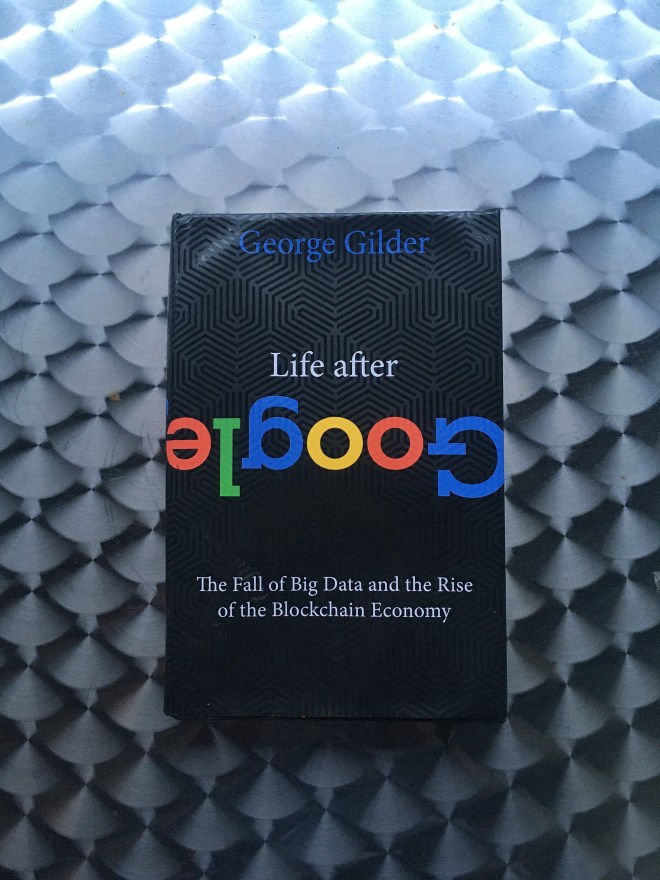
Rarely have I found myself more confused about technology than after reading George Gilder’s “Life After Google – The Fall of Big Data and the Rise of the Blockchain Economy.” A book, supposedly, on the very technology of big data and the blockchain.

In twenty-five chapters across 276 pages, the author attempts to show off but not discuss, how the internet as we know it came into our daily lives. Gilder uses a wealth of buzzwords without ever defining them for the reader. The compounding effect of broad terminology, out-of-place analogies that seemingly disrupt the storytelling, make this book a dense and frustrating read. Even for the tech-savvy. He moves from monetary theory to artificial intelligence to silicon valley startup culture without skipping a beat. Until the underwhelming end of the book, I failed to understand the author’s rage against Google and new, emerging technology companies. In the absence of a clear theme of this book, I tried to theorize that the author set out to warn against Google’s free products, attempts to predict the end of the free product business model as the economy is moving towards cryptographic ledgers, most notably blockchain technology and decentralized cryptocurrency. However, Gilder then compares bitcoin to gold and points out the flaws of a scarce resource to become a stable coin in an economy. How this all ties together or even argues for a future with a decreased need of big data processing remains unclear. Why he chose not to discuss cybersecurity as the most potent threat to fiduciaries within a digitalized, capitalistic system remains unclear. This book is incoherent while being overly focused on ideological aspects. It would have served the readers to restrict the discussion to the actual technology.

With all that in mind, I feel this book has some minuscule merit for a philosophical audience without much need for technical detail. Gilder delivers on creating an entry-level overview for future exploration of blockchain technology, large scale computing and its implementation within an economic system that is supported by for-profit corporations. But beyond that, I feel, I am left more confused than enlightened about the interplay between data processing within financial markets, artificial intelligence deployed to equalize market barriers and blockchain as technology that would enable a seismic shift towards decentralized currencies.